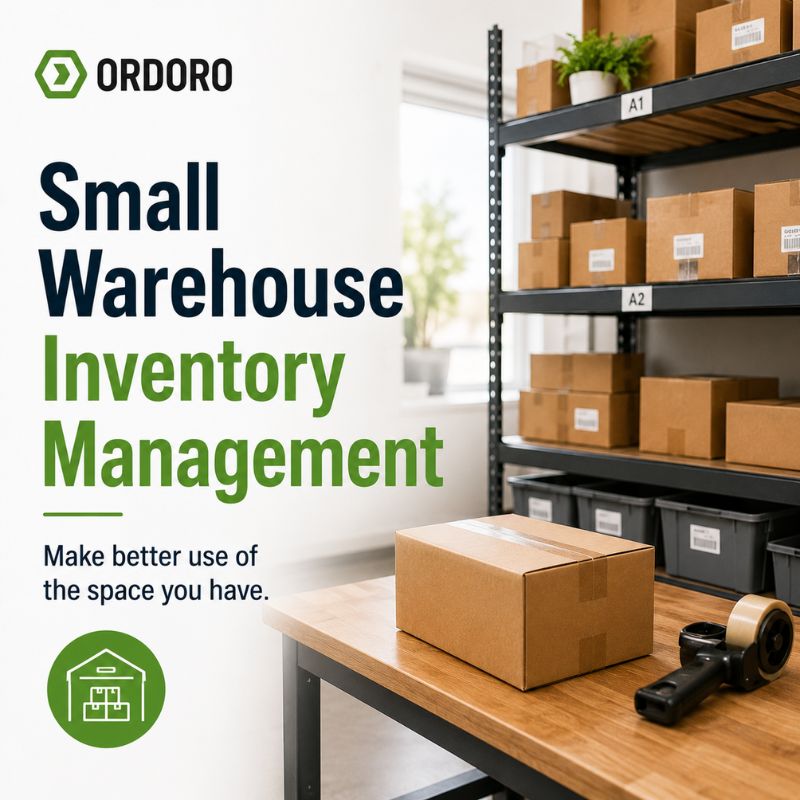
Update: When we originally published this article in 2012, we focused on a common small warehouse inventory management challenge: keeping inventory organized in a bedroom, garage, office, or compact stockroom. That challenge has not disappeared. As order volume and product count grow, limited inventory space can quickly become harder to manage.
A larger warehouse is not always the immediate answer. Better use of the space you already have may improve inventory accuracy, reduce picking time, and delay the expense of moving into a bigger facility.
The goal is not to fit as many products as possible into every available corner. It is to create a safe, organized space where employees can receive, store, find, count, and ship inventory consistently.
Start by Evaluating the Space You Have
Before adding more shelves or moving products around, take a closer look at how the space is currently being used. Identify the areas where inventory enters, where it is stored, where orders are packed, and where returns or damaged products are placed. Look for supplies, equipment, old packaging, and slow-moving products that are using valuable space without supporting daily fulfillment.
Pay attention to the way employees move through the room or warehouse. A crowded storage area may technically hold more inventory, but it can slow receiving and picking when employees constantly have to move boxes out of the way. The most useful layout is not always the one with the greatest storage capacity. It is the one that supports a clear, repeatable workflow.
Create Separate Work Areas
Even a small space should have defined areas for the major parts of the inventory process. Depending on the size of the operation, those areas may include:
- Receiving
- Sellable inventory
- Picking and packing
- Shipping supplies
- Returns
- Damaged or quarantined products
These areas do not need to be large or separated by walls. A labeled shelf, table, rack, or section of the room may be enough.
The important part is preventing different inventory states from becoming mixed together. A returned product waiting for inspection should not sit beside sellable inventory. An incoming shipment should not block the packing station. Shipping boxes and tape should not take over the shelves intended for products.
Separating inventory from general business supplies was one of the recommendations in the original article, and it remains useful today. When everything shares the same limited area, employees are more likely to misplace products or create temporary storage spots that never make it into the inventory record.
Give Every Product a Defined Location
Every stocked product should have a clear place where employees expect to find it. The original article referred to this as creating a “seating chart” for inventory. Today, businesses may use location names such as aisle, rack, shelf, bin, or zone.
A location might be labeled:
Aisle A, Rack 2, Shelf 3, Bin 4
A smaller operation may only need simple names such as:
Shelf A1 or Returns Bin 2
The format matters less than using it consistently.
Employees should avoid placing products wherever there happens to be room. That may solve an immediate storage problem, but it creates extra work later when someone has to pick, count, or investigate the item.
Our guide to preventing misplaced inventory explains how defined locations, consistent SKUs, and physical counts help keep products easier to find.
Use Vertical Space Carefully
Shelving and racking can make better use of vertical space and keep products off the floor. However, adding height should not create a safety problem. Shelves need to be appropriate for the weight and dimensions of the products they hold. Heavy or frequently handled products are generally easier to manage at lower levels, while lighter and slower-moving stock may be stored higher.
Aisles and passageways should remain clear enough for employees and equipment to move safely. OSHA also advises warehouses to follow safe procedures for stacking and storing loads so materials remain secure and do not create falling hazards. Avoid building unstable stacks simply because empty vertical space is available. Storage capacity should never come at the expense of safe access.
Place Fast-Moving Products Near the Packing Area
Not every product deserves the same location. Products ordered frequently should generally be easier to reach than products that sell only occasionally. This reduces the distance employees travel during picking and helps keep the most common orders moving.
This practice is often called warehouse slotting. It involves assigning products to storage locations based on factors such as sales velocity, size, weight, and how often certain products are ordered together. Shopify describes velocity-based slotting as placing the fastest-moving products in the most accessible locations.
A small eCommerce business does not need a complicated warehouse study to apply the idea. Start by identifying:
- Bestselling products
- Items ordered together frequently
- Products that are difficult to lift or handle
- Slow-moving and seasonal inventory
Place frequently picked products closer to the packing area and move slower stock farther away or higher up. Review those locations periodically because product demand can change.
Keep Similar Products Easy to Distinguish
Small spaces can make product confusion more likely, especially when several variations have similar packaging. Products that differ by size, color, material, or pack quantity should have distinct SKUs and readable labels. Avoid placing nearly identical variations together unless employees can identify them easily during receiving and picking.
Clear product labels should match the information employees see in the inventory and order system. When the shelf says one thing, the product packaging says another, and the order uses a third description, mistakes become more likely.
Control Slow-Moving and Excess Inventory
Limited warehouse space often reveals a purchasing problem before it reveals a shelving problem. Products that are not selling continue to occupy space that could be used for faster-moving items. Excess inventory may also increase storage costs, create more counting work, and make the warehouse harder to navigate.
Review sales activity and inventory turnover to identify products remaining in stock longer than expected.
Depending on the product, the business may decide to:
- Reduce future purchase quantities
- Pause replenishment
- Bundle products with stronger sellers
- Offer a promotion
- Return stock to the supplier when allowed
- Discontinue the item
The goal is not to remove every slow-selling product. Some seasonal, specialized, or high-margin items may move slowly by design. The business should understand why the product is being held and whether that use of space remains worthwhile.
Ordoro’s inventory management tools help merchants track inventory quantities, purchasing, receiving, and warehouse activity alongside connected orders.
Use Cycle Counts to Keep the Space Organized
A small storage area can still develop inaccurate inventory. Products may be placed in the wrong bin, left at the packing station, mixed with returns, or moved during a busy period without the change being recorded.
Cycle counting allows employees to count smaller groups of inventory throughout the year instead of waiting for one large annual count. The count is also an opportunity to inspect the storage area. Employees can confirm that products are labeled correctly, remove empty packaging, identify damaged stock, and correct items stored in the wrong location. High-value products, fast-moving SKUs, and products with frequent discrepancies may need to be counted more often.
For additional guidance on receiving, storage, counting, and purchasing, read our inventory management best practices guide.
Plan for Seasonal Overflow
Limited space becomes especially challenging before holiday periods, promotions, or seasonal product launches. Temporary overflow may be necessary, but it should still follow a defined process. Create designated overflow locations rather than placing extra inventory wherever it fits. Record where those products are stored, label the area clearly, and decide when the stock should return to its regular location.
It may also help to stagger supplier deliveries or adjust purchase quantities so the entire seasonal order does not arrive at once. When temporary storage begins blocking receiving, packing, aisles, or emergency access, the business may be carrying more inventory than the space can support safely.
Use More Than One Warehouse When It Makes Sense
A second warehouse or third-party fulfillment location may eventually become more practical than continuing to rearrange one crowded space. Businesses may divide inventory by product category, sales region, fulfillment method, or demand. A second location can reduce pressure on the original warehouse, but it also introduces additional inventory decisions.
The business needs to know:
- Which products are stored at each location
- How orders are assigned
- When inventory should be transferred
- How quantities remain synchronized
- Which location handles returns
Ordoro supports inventory tracking across multiple warehouses and connects that information with purchasing and order activity. Businesses can also review Ordoro’s partners and integrations to see which sales channels and business systems can connect with their workflow.
Know When Organization Is No Longer Enough
Better shelving, product locations, and purchasing decisions can improve limited inventory space, but they cannot create unlimited capacity. It may be time to consider a larger space, another warehouse, or an outside fulfillment provider when:
- Receiving repeatedly blocks fulfillment
- Safe aisles cannot be maintained
- Employees spend too much time moving products to reach other products
- Inventory is stored in several untracked temporary areas
- Seasonal overflow has become permanent
- The space cannot support expected growth
Before expanding, confirm that the real issue is capacity rather than excess inventory or an inefficient layout. Our article on inventory inefficiency warning signs covers other signs that inventory processes may no longer be supporting the business effectively.
Limited Space Requires Better Inventory Visibility
Small warehouses can work well when every product has a defined location and purchasing decisions reflect actual demand. Accurate inventory records help a business avoid ordering products it already has, identify stock that is consuming unnecessary space, and keep multiple storage locations organized.
Small Warehouse Inventory FAQs
How do you organize inventory in a small warehouse?
Create defined areas for receiving, storage, packing, returns, and damaged products. Give every SKU a clear location, place fast-moving items near the packing area, and keep temporary storage to a minimum.
How can a business make more room for inventory?
Use vertical storage safely, reduce excess and slow-moving stock, reorganize products based on sales velocity, and separate shipping supplies from sellable inventory. Better purchasing decisions may free more space than adding shelves.
When should a business move to a larger warehouse?
Consider expanding when receiving blocks fulfillment, safe aisles cannot be maintained, temporary storage becomes permanent, or employees spend too much time moving products to reach other inventory.
Make Better Use of the Inventory Space You Have
Limited warehouse space becomes easier to manage when products have defined locations, stock levels reflect demand, and receiving, storage, and fulfillment work from dependable inventory information.
Ordoro helps eCommerce teams manage inventory, purchasing, receiving, multiple warehouses, and connected order workflows from one platform. Explore Ordoro’s Inventory Management Tools