For years, small businesses looking to grow online had a familiar choice: build your own website, sell through a marketplace, or try to do both without losing track of what you sold where. SMB multichannel selling is changing that picture, with more businesses appearing to choose that third option.
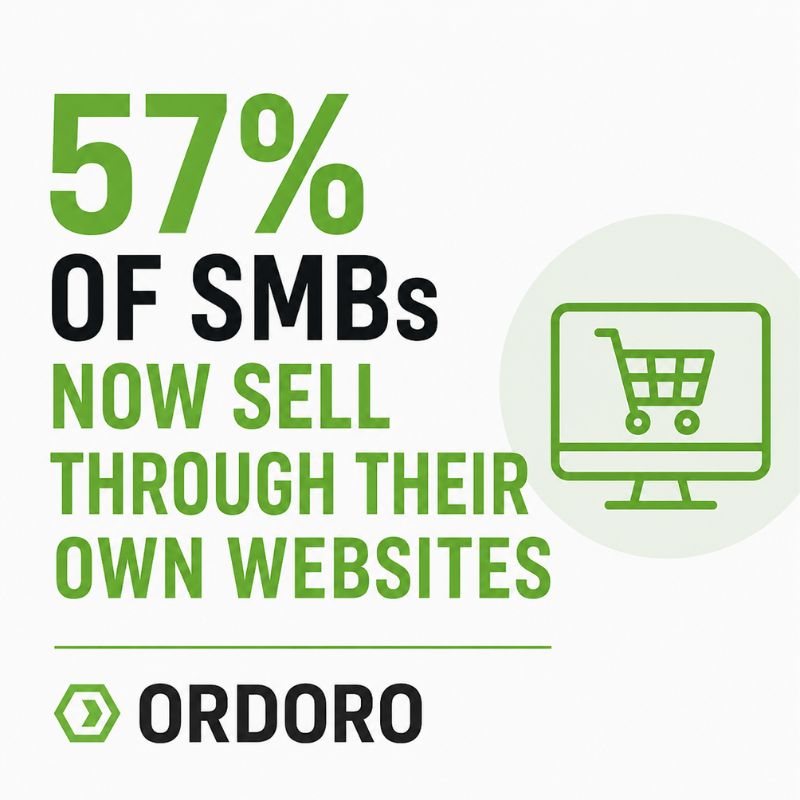
New PYMNTS Intelligence data shows that 57% of small and midsize businesses now sell through their own websites, putting owned websites just four percentage points behind physical stores at 61%. At the same time, marketplaces, social media, mobile apps, and other digital channels continue to play an important role in how SMBs reach customers.
The interesting part isn’t that small businesses suddenly discovered websites. It’s that owning a storefront increasingly appears to be one piece of a much bigger sales mix.
For eCommerce merchants, that’s good news. More places to reach customers can create more opportunities to sell. Of course, every new front door eventually leads back to the same inventory shelf.
The Numbers Worth Knowing
- 57% of SMBs sell through their own websites, compared with 61% selling through physical stores.
- Digital channels generate 57% of SMB sales on average, compared with 41% from physical channels.
- 61% of SMBs are hybrid sellers, meaning neither physical nor digital channels account for more than 75% of their sales.
- Among businesses using third-party marketplaces, 48% reported increased sales through that channel.
- Social media sellers are seeing momentum too, with 46% reporting sales growth through social channels.
- SMBs with more than $1 million in annual revenue reported substantially stronger growth than the smallest businesses in the research.
Taken together, the numbers tell a more interesting story than “small businesses have websites.” Multichannel selling is becoming normal for SMBs.
Your Website and Marketplaces Don’t Have to Be Rivals
There’s an understandable appeal to owning your storefront. A merchant has more control over the brand, customer experience, promotions, and relationship with the shopper. You aren’t building your entire business on somebody else’s digital property. Marketplaces offer something different: access to customers who are already there.
That’s why treating owned websites and marketplaces as an either-or decision increasingly feels outdated. A merchant might use Amazon or Walmart to reach a huge pool of shoppers, eBay for another audience, and Shopify or another eCommerce platform to build a direct relationship with customers on its own site.
The PYMNTS data backs up that broader shift. Its four-year analysis describes successful SMBs as increasingly multichannel by default, including businesses using both an owned website and third-party marketplaces.
For a growing business, the question becomes less “Which channel should we sell on?” and more “Which combination of channels makes sense for us?” That’s a much more interesting question. It’s also where things can get messy.
More Front Doors Still Lead to the Same Stockroom
Imagine you have 12 units of a popular product left. Your Shopify store wants to sell them. Amazon would also be delighted to sell them. So would Walmart. And eBay has no objection to joining the party. Unfortunately, you still only have 12.
That’s the operational side of multichannel growth that doesn’t always make it into the exciting “expand your reach” conversation. Every new sales channel creates another place where a customer can place an order, but those orders may all draw from the same physical inventory.
As order volume grows, manually keeping those quantities aligned gets harder. A product sells on your website, but another marketplace doesn’t know about it yet. Then another customer buys the same unit somewhere else, and suddenly your successful multichannel strategy has produced an unsuccessful inventory problem.
For smaller businesses, this matters because the goal of adding a channel is to create more opportunity without creating an equal amount of administrative work. You shouldn’t need another employee whose entire job is telling five websites that somebody just bought a T-shirt.
The Website Gives You Control. The Marketplace Gives You Reach.
There are good reasons merchants want both. An owned website gives businesses control over how products are presented, how customers move through checkout, what promotions they see, and how the brand communicates with them after the sale. It can also give merchants more direct insight into their customers and reduce dependence on any single marketplace.
Meanwhile, marketplaces can introduce products to shoppers who may never have searched for the merchant directly. That reach can be particularly valuable for smaller businesses still building brand recognition.
Social commerce and mobile apps add even more possibilities. PYMNTS found that among businesses using each channel, 61% of delivery-aggregator users reported increased sales there, while 51% of businesses with owned mobile apps and 46% of social media sellers reported growth through those channels.
The takeaway isn’t that merchants need to sell everywhere. More channels aren’t automatically better. The opportunity is being able to choose the channels that work for your business without turning the back office into a juggling act.
The Real Multichannel Work Starts After Someone Clicks Buy
Customers don’t particularly care how complicated your sales-channel strategy is. They found the product, bought it, and would now like it to arrive.
Behind that very simple expectation is an order that needs to get into your workflow. Inventory needs to adjust. Somebody needs to pick and pack the product, buy a shipping label, send tracking information back to the right channel, and keep the customer updated. Then another order comes in from somewhere else.
For merchants fulfilling their own orders, this is where multichannel eCommerce becomes an operations story rather than just a marketing strategy. Adding your own website doesn’t eliminate fulfillment because you own the storefront. If anything, it creates another source of orders that needs to work alongside everything you’re already selling.
That’s exactly the kind of problem Ordoro’s multichannel eCommerce tools are built around. Orders from supported marketplaces and shopping carts can flow into one place, while inventory, shipping, and fulfillment stay connected across the business.
I’d internally link “Ordoro’s multichannel eCommerce tools” to the most relevant multichannel/integrations page on Ordoro.com. The goal isn’t to make every merchant sell everywhere. It’s to make selling in more than one place considerably less chaotic.
Growth Doesn’t Require Being Everywhere
One part of the PYMNTS research is particularly worth keeping in perspective. Digital channels are becoming increasingly important, but the data doesn’t suggest that every SMB needs a website, marketplace account, social storefront, mobile app, and whatever new channel appears next Tuesday.
Instead, it shows that businesses are building a broader mix of ways to reach customers. In fact, digital channels now generate 57% of SMB sales on average, and 61% of SMBs fall into the hybrid category rather than being overwhelmingly physical- or digital-led.
For merchants, that makes channel expansion something to approach deliberately. A new marketplace may give you access to a valuable audience. Your own website may give you more control over the customer relationship. Another channel may add plenty of complexity without enough sales to justify it.
The important part is having an operation that can support the channels that actually earn their place.
A Few Questions to Ask Before Adding Another Channel
If your business is thinking about expanding beyond its current storefronts, start with the customer rather than the technology. Is there an audience on that channel you aren’t reaching today? Does the platform fit what you sell? Will the potential sales justify the fees and additional operational work?
Then look behind the scenes. Determine how orders will reach your fulfillment team, how inventory will stay accurate, how tracking gets sent back, and what happens when an item sells on two channels within minutes of each other.
For businesses building their own eCommerce sites while continuing to sell through marketplaces, shared inventory deserves particular attention. The website may belong to you, but the products sitting on the warehouse shelf are still the same products available everywhere else.
More sales channels should create more opportunities to sell, not more opportunities to accidentally sell the same thing twice.
Frequently Asked Questions About SMB Multichannel Selling
How many SMBs sell through their own websites?
According to PYMNTS Intelligence, 57% of SMBs now sell through their own websites, compared with 61% that sell through physical stores.
Are small businesses moving away from marketplaces?
The data doesn’t suggest that. Third-party marketplaces remain part of the broader digital sales mix, and 48% of SMBs using marketplaces reported increased sales through that channel. The bigger trend is toward businesses using multiple channels rather than relying entirely on one.
What percentage of SMB sales come from digital channels?
PYMNTS found that digital channels generate 57% of SMB sales on average, while physical channels account for 41%.
What does multichannel eCommerce mean?
Multichannel eCommerce means selling products through more than one sales channel. That could include a merchant’s own website alongside marketplaces such as Amazon, Walmart, or eBay and other digital channels.
Why is inventory management important for multichannel sellers?
When several sales channels draw from the same physical inventory, a sale on one channel needs to be reflected across the others. Without accurate inventory synchronization, merchants increase the risk of overselling products they no longer have available.
Does selling through your own website mean you still need fulfillment software?
If you fulfill your own orders, yes, you still need a process for managing orders, inventory, shipping, and tracking. An owned website changes where the customer buys; it doesn’t make the fulfillment work disappear.
Owning the Storefront Doesn’t Mean Going It Alone
Seeing 57% of SMBs selling through their own websites is encouraging because it shows smaller businesses gaining more ways to reach customers on their own terms. But the bigger story isn’t websites replacing marketplaces or digital commerce replacing physical stores. It’s businesses building a mix.
A merchant can own the customer experience on its website while still using marketplaces to reach shoppers elsewhere. The challenge is making sure all of those front doors lead into an operation that knows what was sold, what’s still available, and what needs to ship next.
That’s where multichannel selling either starts to feel like growth or starts to feel like five browser tabs arguing over the last item in stock.
Selling through your own website and marketplaces? Explore Ordoro’s integrations to see how you can bring orders, inventory, shipping, and fulfillment together across your sales channels.