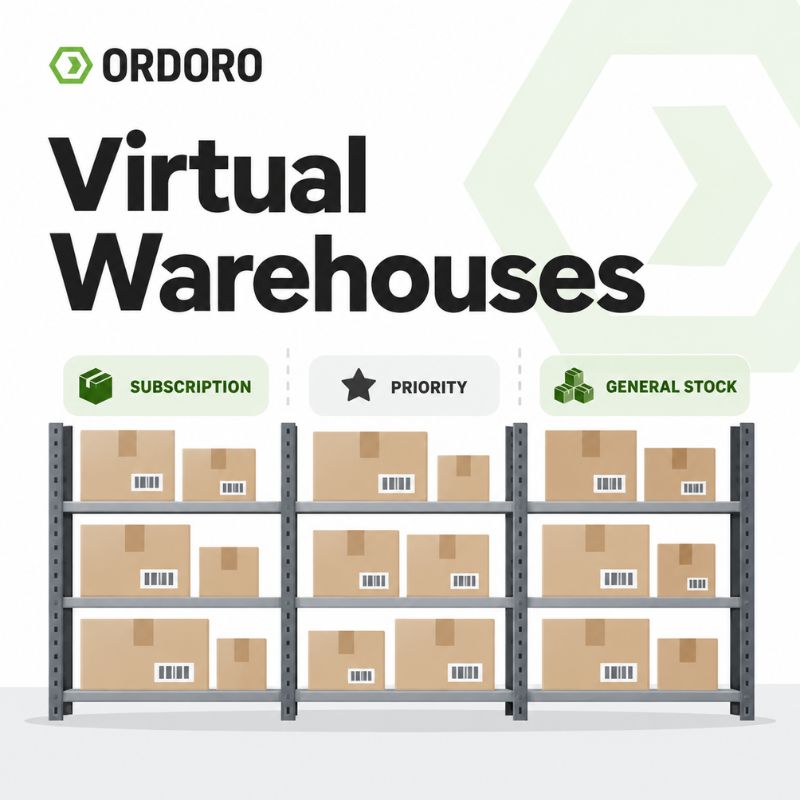
As an eCommerce business grows, inventory does not always fit neatly into one warehouse, one sales channel, or one fulfillment workflow. Some products may be stored at a second location. A supplier might fulfill certain orders directly. A 3PL could handle part of the catalog. Or the inventory may never leave the building at all, but the business still needs a way to separate products for subscription customers, wholesale orders, or another priority workflow. That is where a virtual warehouse can come in.
A virtual warehouse gives eCommerce businesses a way to separate inventory or fulfillment activity inside their operations system without necessarily creating another physical storage location. It can help teams understand not only how much inventory they have, but where it belongs, who it is intended for, and how it should move through fulfillment.
What Is a Virtual Warehouse?
A virtual warehouse is a logical inventory or fulfillment location created inside an eCommerce operations system. It may correspond to an actual warehouse, but it does not have to represent a separate building.
Instead, businesses can use virtual warehouses to organize inventory around the way their operation works. One virtual warehouse might represent a physical fulfillment center while another represents inventory held by a supplier or 3PL. A business could also use a virtual warehouse to separate inventory intended for subscriptions, wholesale customers, a particular sales channel, or another fulfillment workflow. That distinction is important because inventory is not always separated by geography.
Two products can be sitting on the same shelf while belonging to different inventory or fulfillment groups inside the system. In that case, the virtual warehouse is helping answer a different question. Instead of simply asking, “Where is this product?” the business may need to know, “What is this inventory available for?”
Virtual Warehouses vs. Physical Warehouses
A physical warehouse is an actual location where inventory is received, stored, picked, packed, and shipped. A virtual warehouse is a way of representing inventory or fulfillment activity within software.
Sometimes the two line up directly. A company with warehouses in Austin and Dallas may create a separate warehouse in its system for each physical location so it can track inventory independently. Other times, the separation is entirely operational.
Imagine an eCommerce business storing 100 units of the same product in one building. Seventy units are available for normal orders, while 30 are intended for upcoming subscription shipments. Physically, all 100 units may be in the same warehouse. Operationally, however, the company may not want to treat all 100 as freely available inventory.
A virtual warehouse can provide a way to keep those inventory pools separate without requiring another facility.
Why eCommerce Businesses Use Virtual Warehouses
The need for virtual warehouses usually appears as an operation becomes more complicated. When every product is stored in one location and every order follows the same path, a single warehouse may be enough. As the business adds channels, suppliers, fulfillment partners, subscription programs, or additional locations, one inventory number may stop telling the whole story.
A company may know it has 500 units of a product overall, but that does not necessarily mean all 500 units are available to every customer or fulfillment workflow. Some may be held at another location. Others may belong to a 3PL. Some may be reserved for wholesale orders. Some may need to remain available for subscription customers whose recurring orders are about to process.
Virtual warehouses give businesses another way to organize those differences while maintaining a clearer picture of inventory availability.
That becomes increasingly useful as part of a broader eCommerce inventory management process. Accurate inventory counts are important, but growing businesses may also need to understand which inventory is available for which part of the operation.
Using Virtual Warehouses for Subscription and Priority Orders
Subscription businesses offer a good example of why a virtual warehouse does not always need to represent another physical location. Consider a business that gives subscription customers priority shipping. Those customers expect their recurring orders to be fulfilled consistently, so the business may want to make sure inventory remains available when those orders are ready to process. The products could still be stored alongside regular inventory in the same warehouse. The difference is how the business wants to treat them.
By separating subscription inventory into a virtual warehouse or logical inventory location, the business can create a clearer distinction between products intended for recurring customers and products available for standard orders.
That can help answer questions such as how much inventory is available for upcoming subscriptions, whether enough stock has been set aside, and how much remains available for everyone else.
It can also support a priority fulfillment workflow. Subscription orders may need to be identified or handled before standard orders even though they are being picked from the same physical facility.
In this case, the virtual warehouse is less about where the inventory sits and more about how the business wants that inventory handled.
Separating Inventory Without Moving It
Subscriptions are only one example.
A business may want to separate inventory for wholesale customers while keeping another quantity available for direct-to-consumer orders. Marketplace inventory may need to be treated differently from inventory sold through the company’s own website. Some stock may be reserved for replacement orders, preorders, or another special fulfillment process.
Without that separation, inventory can look available even when the business already has plans for it.
Suppose a company has 200 units on hand and knows 75 will be needed for subscription renewals next week. If all 200 appear as unrestricted inventory, another channel could consume those units before the subscription orders are processed. A virtual warehouse structure can help create clearer boundaries between those inventory pools.
It does not replace good inventory forecasting, reorder points, or safety stock. Instead, it gives the business another layer of visibility into how existing inventory is allocated across the operation.
How Virtual Warehouses Connect to Order Fulfillment
Once inventory is divided between warehouses, locations, or fulfillment workflows, the next question becomes what happens when an order arrives. A business may need to determine whether the inventory is available for that customer, which location should fulfill the order, whether a supplier should handle it, or whether the order needs to receive priority treatment.
For a company fulfilling everything from one warehouse, those decisions may happen almost automatically. With multiple inventory locations or fulfillment paths, there may be more to consider.
One product might be available at the main warehouse and a 3PL. Another may only be available through a supplier. Some inventory may be reserved for subscriptions. An order containing several products may even need to be fulfilled from more than one source. This is where warehouse structure starts connecting inventory management with order routing.
The warehouse is no longer simply the place where inventory lives. It becomes part of the decision about how the order moves through fulfillment.
Virtual Warehouses for Suppliers, Dropshipping, and 3PLs
Virtual warehouses can also help represent inventory that is not physically under the seller’s control. In a dropshipping workflow, for example, the eCommerce business receives the order while the supplier stores and ships the product. That supplier inventory may need to remain separate from products the business fulfills internally.
A similar situation occurs with third-party logistics providers. Inventory may belong to the eCommerce business but physically sit inside a 3PL facility. Representing those fulfillment sources separately can give the team a clearer picture of where inventory is available and who is responsible for getting an order out the door.
This can become especially useful when the business uses several fulfillment methods at the same time. Some products may ship internally, some from a supplier, and others through a 3PL. Treating all of that inventory as though it exists in one place can quickly make fulfillment harder to understand.
Connecting Virtual Warehouses to Inventory Management
Virtual warehouses do not operate separately from the rest of the inventory workflow. If a warehouse represents a physical location, inventory needs to be received into the correct place. If 50 units arrive at one facility but are recorded under another warehouse, the total inventory might look correct while the location-level quantities are wrong.That can create problems later when someone tries to fulfill an order from inventory that is not physically there.
A clear receiving inventory process helps keep those location-level quantities accurate from the moment products arrive.
The same connection exists with purchasing. A purchase order tells the team what was ordered, how much is expected, and which supplier is providing it. When multiple warehouses are involved, the destination of that incoming inventory can become another important part of the purchasing workflow.
Location-level visibility can also support efforts to prevent stockouts. A product may be unavailable at one location while inventory remains somewhere else, or a combined inventory total may make stock appear more available than it really is for a particular workflow.
The more complex the operation becomes, the more useful it is to know not just how much inventory exists, but how that inventory is distributed and what it is available for.
When Does a Virtual Warehouse Make Sense?
A virtual warehouse is useful when there is a real operational reason to separate inventory or fulfillment activity.
That might include businesses that:
- Reserve inventory for subscription or priority customers
- Keep wholesale and direct-to-consumer inventory separate
- Operate from multiple physical locations
- Use a 3PL for part of their fulfillment
- Have suppliers or dropshippers fulfill certain products
- Need different inventory pools for different channels
- Use different fulfillment workflows for different products or orders
Not every eCommerce business needs that additional structure.
If all inventory is stored in one location, every unit is available to every customer, and every order follows the same fulfillment process, one warehouse may be perfectly adequate. Adding extra virtual locations without a clear reason can create more complexity instead of reducing it.
The goal is not to create more warehouses inside the software. It is to make the system reflect how the business actually operates.
Virtual Warehouses and Warehouse Management
Virtual warehouses and physical warehouse management address different parts of the same workflow. Warehouse management deals with the day-to-day movement of products through a physical facility, including receiving, putaway, inventory counts, picking, packing, and shipping.
Virtual warehouses add another layer by helping define how inventory and fulfillment responsibilities are organized across the business.
Inside the physical warehouse, the question might be, “Where on the shelf is this product?”
At the operational level, the question could instead be, “Which inventory pool does this product belong to, and which orders should have access to it?”
Growing eCommerce businesses may eventually need answers to both.
Managing Warehouse Workflows With Ordoro
As eCommerce operations become more complex, warehouse locations begin connecting several parts of the workflow.
Inventory needs to be associated with the right location. Orders need to reach the right fulfillment source. Incoming inventory needs to be received correctly. And when a shipment is ready to go out the door, the correct Ship From location becomes part of the shipping process.
Ordoro helps eCommerce businesses manage inventory, orders, purchasing, warehouses, and shipping within a connected operational workflow. That connection becomes particularly important when a business no longer has one simple answer to the question, “Where does this order ship from?”
In the next part of this series, we will look at another part of that decision: comparing shipping rates, services, and delivery options before choosing how an order should ship.
Frequently Asked Questions About Virtual Warehouses
What is a virtual warehouse in eCommerce?
A virtual warehouse is a logical inventory or fulfillment location inside an eCommerce operations system. It can represent a physical warehouse, supplier, 3PL, sales channel, customer group, or another inventory or fulfillment workflow.
Does a virtual warehouse need to be a physical location?
No. Inventory assigned to different virtual warehouses can still be stored in the same physical facility. The warehouse can be used to separate inventory logically rather than geographically.
Can a virtual warehouse be used for subscription inventory?
Yes. A business may use a virtual warehouse or similar logical inventory structure to separate products intended for subscription customers, including situations where those customers receive priority fulfillment.
Can virtual warehouses help reserve inventory?
A virtual warehouse can help separate inventory intended for a specific customer group, channel, or workflow. The exact way inventory is reserved or allocated will depend on the system being used.
Can a supplier or 3PL be represented as a virtual warehouse?
Yes, depending on the eCommerce operations system. Separate warehouse locations can be used to represent inventory held or fulfilled by suppliers, dropshippers, or 3PL partners.
What is the difference between a virtual warehouse and a physical warehouse?
A physical warehouse is an actual facility where products are stored and fulfilled. A virtual warehouse is a logical location inside a software system. It may correspond to a physical facility, but it can also represent another inventory or fulfillment distinction.
How do virtual warehouses affect shipping?
When warehouse locations represent different physical shipping origins, the location an order ships from can affect carrier services, delivery times, and shipping rates. A virtual warehouse used only to separate an internal workflow may still ship from the same physical origin.
Know What You Have and How It Should Be Used
Inventory management starts with knowing what you have. As eCommerce operations grow, businesses often need more context than a single inventory number can provide. They may also need to know where inventory is located, which customers it is intended for, who is responsible for fulfilling it, and which orders should receive priority.
A virtual warehouse can help organize those distinctions without requiring another building or physically separating every product.
Sometimes it represents a warehouse across the country. Sometimes it represents inventory held by a supplier or 3PL. And sometimes the products stay exactly where they are while the virtual warehouse helps the business manage them differently. That makes virtual warehouses one part of a broader eCommerce operations workflow connecting inventory, fulfillment, and shipping.
Ready to bring your inventory and fulfillment workflows together? Start a free trial of Ordoro and see how connected eCommerce operations can help keep orders moving.