Update: We originally published this article in 2010 with advice for businesses setting up an online store. eCommerce technology has changed considerably since then, so we updated the article to compare SaaS vs. self-hosted eCommerce for today’s merchants.
Choosing an eCommerce platform is one of the first major technology decisions an online business makes. Some businesses use a hosted software platform that manages the technical infrastructure for them. Others host and maintain their own eCommerce software for greater control.
The right choice depends on the business’s budget, technical resources, customization needs, and growth plans.
What Is a SaaS eCommerce Platform?
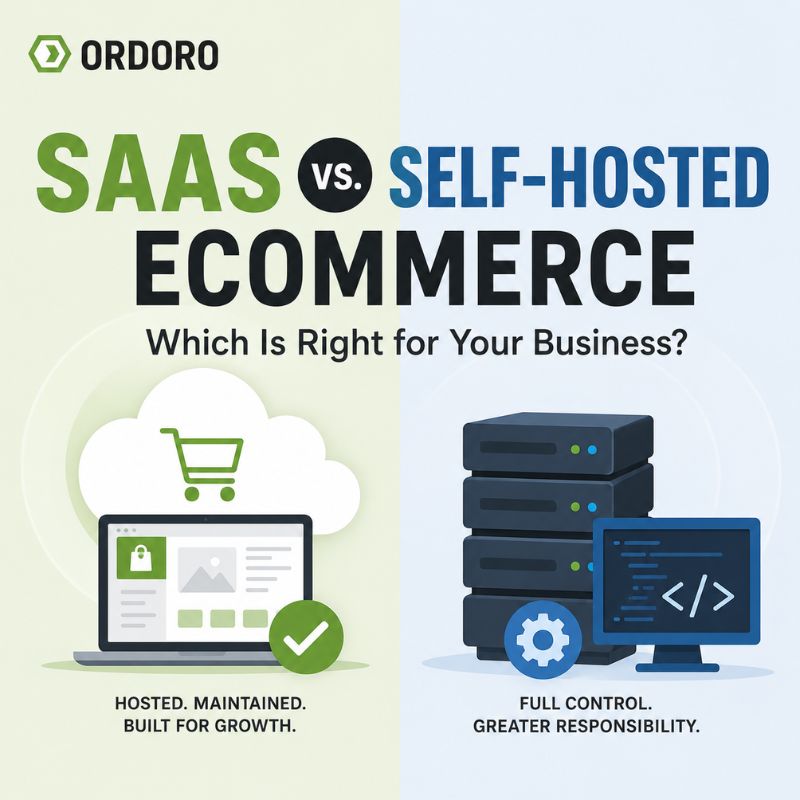
A software-as-a-service, or SaaS, eCommerce platform is hosted and maintained by the software provider. Merchants usually pay a monthly or annual subscription to access the platform. The provider manages much of the technical infrastructure, including:
- Hosting
- Software updates
- Security patches
- Platform maintenance
- Basic backups
- Server performance
- New feature releases
Shopify, BigCommerce, and similar hosted platforms are common examples. SaaS platforms can help businesses launch more quickly because merchants do not need to install software or maintain their own servers.
What Is a Self-Hosted eCommerce Platform?
A self-hosted eCommerce platform gives the business more responsibility for the software and technical environment. The merchant may need to arrange:
- Website hosting
- Software installation
- Security updates
- Backups
- Performance monitoring
- Technical troubleshooting
- Developer support
- Ongoing maintenance
Self-hosted software can provide more control over the store’s code, infrastructure, and customization. However, that flexibility may require more time, technical expertise, and expense.
SaaS vs. Self-Hosted eCommerce at a Glance
| Consideration | SaaS platform | Self-hosted platform |
|---|---|---|
| Setup | Usually faster | Usually more technical |
| Hosting | Managed by provider | Managed by merchant |
| Updates | Generally automatic | Merchant manages updates |
| Customization | Limited by platform | Greater control |
| Security | Shared with provider | Merchant is responsible |
| Maintenance | Included in subscription | Requires internal or outside support |
| Initial cost | Often lower | May require more upfront investment |
| Ongoing cost | Subscription and app fees | Hosting, development, and maintenance |
| Scalability | Managed within platform limits | Depends on infrastructure |
Neither option is automatically better. The goal is to choose the model that matches how the business operates.
Compare the Complete Cost
A SaaS subscription may appear more expensive than free or open-source software, but the software license is only one part of the cost. A self-hosted platform may also require spending on:
- Hosting
- Developers
- Security tools
- Premium extensions
- Testing
- Backups
- Emergency support
- Performance improvements
- Software upgrades
SaaS platforms may have additional expenses as well, including transaction fees, premium themes, apps, and higher-tier plans.
Compare the total cost of ownership rather than looking only at the monthly subscription or software price.
Consider Your Technical Resources
A self-hosted store may work well for a business with an experienced technical team or a reliable development partner. Without that support, software updates, security problems, or website failures can interrupt sales and consume time that the team could spend elsewhere.
A SaaS platform allows the provider to handle more of the technical workload. This can be especially valuable for smaller businesses that do not have an internal IT or development team.
Evaluate Customization and Control
Self-hosted software generally gives businesses more freedom to modify the code, infrastructure, and checkout experience. That control may be important for merchants with:
- Highly specialized workflows
- Unusual checkout requirements
- Complex product configurations
- Custom security or hosting requirements
- Dedicated development resources
A SaaS platform usually offers customization through themes, applications, APIs, and integrations. That may provide enough flexibility for many small and midsize eCommerce businesses without requiring them to maintain the full system.
Plan for Security and Maintenance
Every online store must protect customer and business information. With a SaaS platform, the provider handles much of the underlying platform security. The merchant still needs to manage account permissions, passwords, connected applications, and internal security practices.
With a self-hosted platform, the business takes on greater responsibility for server security, software updates, backups, monitoring, and vulnerability management. The ability to customize the platform also creates an obligation to maintain it properly.
Look Beyond the Storefront
The storefront is only one part of an eCommerce operation. As order volume grows, merchants may also need systems for:
- Inventory management
- Order management
- Shipping
- Purchasing
- Supplier management
- Kitting and bundles
- Multiple warehouses
- Returns
- Dropshipping
Before choosing a platform, review which systems it can connect with and whether those integrations support the business’s current and future workflows.
Ordoro connects with leading storefronts and marketplaces so merchants can bring inventory, orders, and shipping workflows together. Review Ordoro’s eCommerce integrations to see which platforms and sales channels are supported.
Think About Multichannel Growth
A business may begin with one storefront and later expand to marketplaces or additional websites. Selling through multiple channels can increase reach, but it can also create operational challenges. Orders may arrive in different systems, while stock quantities must remain accurate everywhere.
A multichannel inventory management system can help synchronize quantities and reduce the risk of overselling as the business expands.
Merchants should consider these future needs before selecting technology that may be difficult to connect or replace later.
When Does a SaaS eCommerce Platform Make Sense?
A SaaS platform may be a good fit when the business:
- Wants to launch quickly
- Has limited technical resources
- Prefers predictable subscription costs
- Does not want to maintain hosting or software
- Can operate within the platform’s customization options
- Wants access to an established app and integration marketplace
For many small and midsize merchants, SaaS provides a practical balance of functionality, support, and ease of maintenance.
When Does Self-Hosted eCommerce Make Sense?
A self-hosted platform may be appropriate when the business:
- Needs extensive customization
- Has experienced developers available
- Requires control over its hosting environment
- Has specialized security or compliance requirements
- Can support ongoing maintenance and testing
- Has workflows that hosted platforms cannot accommodate
Greater control can be valuable, but only when the business has the resources to manage it responsibly.
SaaS vs. Self-Hosted eCommerce FAQs
Is Shopify a SaaS eCommerce platform?
Yes. Shopify is a hosted eCommerce platform. Shopify manages the software and hosting while merchants access the platform through a subscription.
Is self-hosted eCommerce cheaper than SaaS?
Not always. Self-hosted software may have a low or free license cost, but hosting, development, security, maintenance, and upgrades can increase the total expense.
Is SaaS better for small eCommerce businesses?
SaaS is often a practical option for small businesses because it reduces the technical work required to launch and maintain a store. The best choice still depends on the business’s needs and resources.
Can a SaaS store connect with inventory and shipping software?
Yes. Many SaaS platforms support integrations with inventory, order management, shipping, accounting, and other business systems.
Can a business switch eCommerce platforms later?
Yes, but migrations can require significant planning. Businesses may need to move products, customer data, orders, URLs, integrations, and other information without disrupting operations.
What should an eCommerce business consider before choosing a platform?
Consider total cost, technical resources, customization, security, scalability, integrations, multichannel plans, and the systems needed to manage inventory and fulfillment.
Choose Technology That Supports the Entire Operation
The best platform in a SaaS vs. self-hosted eCommerce comparison is not necessarily the one with the most features. It is the one that fits the business’s technical resources, customer experience, and long-term operational needs.
Once the storefront is running, merchants still need to manage what happens after customers place their orders.
Ordoro helps eCommerce businesses connect sales channels, synchronize inventory, organize orders, compare shipping rates, create labels, and manage fulfillment from one place. See Ordoro’s eCommerce Integrations
For merchants who already know their storefront is supported and are actively evaluating an operations platform: Start Your Free Trial