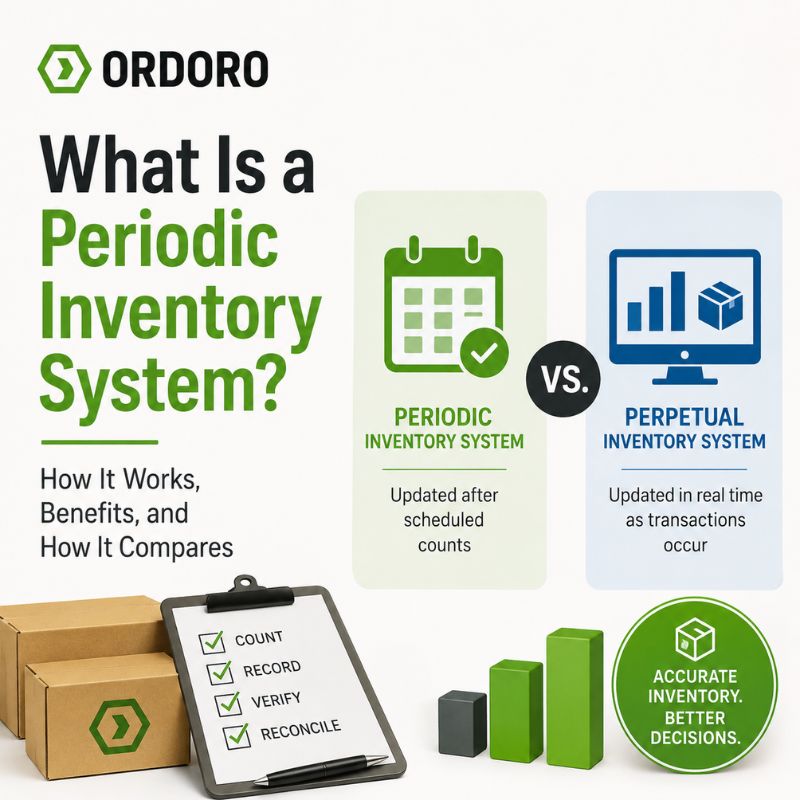
Update: We originally published this article in 2012 to explain one of the basic types of inventory systems. Since then, inventory technology has changed considerably, but the distinction between periodic and perpetual inventory remains important. This updated guide explains how a periodic inventory system works, when it may still be useful, and why many growing eCommerce businesses need more frequent inventory updates.
A periodic inventory system determines inventory quantities and values at specific intervals rather than updating records after every sale, receipt, return, or adjustment.
The business may count inventory weekly, monthly, quarterly, or annually. Between those counts, the recorded quantity may not reflect exactly what is physically available. This approach can be simple and inexpensive, but it provides limited visibility between counts. That becomes more challenging when products sell through several channels or move across warehouses, suppliers, returns areas, and fulfillment workflows.
How Does a Periodic Inventory System Work?
Under a periodic system, inventory records are updated after the business completes a physical count. During the accounting period, purchases are recorded separately rather than being added continuously to the inventory balance. At the end of the period, the business counts the products it still has and uses that ending inventory value to calculate cost of goods sold.
The basic formula is:
Beginning inventory + purchases − ending inventory = cost of goods sold
For example, a business begins the month with $20,000 in inventory, purchases another $8,000, and counts $10,000 remaining at the end of the month. Its cost of goods sold for that period would be $18,000.
This method can provide the information needed for financial reporting, but it does not automatically tell the business exactly how much of each product is available between counts.
Periodic vs. Perpetual Inventory
The main difference between periodic and perpetual inventory is when the records change.
A periodic inventory system updates inventory at scheduled intervals after a count. A perpetual inventory system updates quantities continuously as products are received, sold, returned, transferred, or adjusted.
| Periodic inventory | Perpetual inventory |
|---|---|
| Updated after scheduled counts | Updated as transactions occur |
| Provides limited visibility between counts | Provides more current quantity information |
| Often relies heavily on physical counts | Uses software to record ongoing inventory movement |
| May work for small, simple operations | Better suited to growing or multichannel businesses |
| Discrepancies may remain hidden until the next count | Discrepancies can be identified sooner |
A perpetual system does not eliminate physical counting. Businesses still use cycle counts and full physical inventories to confirm that the system matches what is actually on the shelf. The difference is that a perpetual system provides a working inventory record between those counts.
Benefits of Periodic Inventory
A periodic system may still be appropriate for a small business with a limited catalog, one storage location, and relatively few inventory transactions.
Its advantages may include:
- A simpler process
- Lower initial software costs
- Fewer daily inventory updates
- Straightforward period-end accounting
- A practical starting point for very small operations
A local store with a small number of products may be able to count inventory regularly without needing a more advanced system. The important question is whether the business can operate confidently without knowing the exact quantity of each product throughout the period.
Limitations of Periodic Inventory
The biggest limitation is the lack of current inventory visibility. A product may appear available based on the last count even though several units have since been sold, damaged, returned, or misplaced. The business may not discover the difference until the next physical inventory.
That can lead to:
- Overselling
- Delayed or canceled orders
- Unnecessary purchasing
- Products running out unexpectedly
- Difficulty answering customer questions
- Limited visibility across sales channels
- Larger adjustments at the end of the period
The longer the interval between counts, the longer an error can remain hidden. A periodic system also makes it harder to understand exactly when or why a discrepancy occurred. If the count is wrong at the end of the month, the cause may involve receiving, picking, returns, damage, theft, or a recording mistake that happened weeks earlier.
When Can a Periodic Inventory System Still Work?
Periodic inventory may still be sufficient when the operation is simple and inventory accuracy is not changing rapidly.
It may work when:
- One person manages the inventory
- The catalog is small
- Products are stored in one location
- Sales volume is relatively low
- Inventory is not shared across several channels
- Physical counts are easy to complete
- The business does not need real-time availability
Even in those cases, the business should establish a consistent counting schedule and document how purchases, returns, damage, and adjustments are handled. Once the business begins spending more time correcting inventory than managing it, the simplicity of the periodic system may no longer be saving time.
Why eCommerce Businesses Often Need More Frequent Updates
An eCommerce business may receive orders at any time through several storefronts or marketplaces. Those channels may all be selling the same available stock. If inventory only changes after a weekly or monthly count, the business may continue accepting orders for products that are no longer available.
The challenge increases when the operation adds:
- Multiple sales channels
- More SKUs and variations
- Several warehouses
- Kits and bundles
- Purchase orders and incoming stock
- Returns and damaged inventory
- Dropshipping suppliers
- Wholesale or manual orders
These workflows create inventory movement throughout the day. A system that only captures the final count does not provide enough information to manage each transaction as it happens. For more on comparing available systems, read our guide to choosing inventory management software for eCommerce.
Physical Counts Still Matter
Moving to perpetual inventory software does not mean the business can stop counting products. System quantities can still become inaccurate because of receiving mistakes, incorrect SKUs, misplaced products, unrecorded damage, picking errors, or returns that were handled incorrectly.
Physical counts help verify the records and identify where the process may be breaking down. Many businesses use cycle counting rather than waiting for one large annual count. Cycle counts review smaller groups of products on a regular schedule. Fast-moving, high-value, or frequently miscounted items may be reviewed more often than stable products.
Our guide to preventing misplaced inventory explains how receiving, storage locations, consistent SKUs, and regular counts can make stock easier to find and trust.
Moving From Periodic to Perpetual Inventory
A business does not necessarily need to replace its entire process overnight. The transition often begins by identifying which inventory events need to be recorded more consistently. These may include sales, receipts, returns, transfers, damage, and stock adjustments.
The business should also decide which system will serve as the source of truth for inventory quantities. Before choosing a platform, confirm that it can support the workflows the business actually uses, including:
- Sales-channel integrations
- Purchase orders and receiving
- Multiple warehouses
- Kits and bundles
- Inventory adjustments
- User permissions
- Reporting and history
- Order and shipping connections
Review Ordoro’s integrations to see which sales channels, carriers, suppliers, and business systems can connect.
Ordoro’s inventory management tools help eCommerce businesses track quantities, manage purchase orders and receiving, support multiple warehouses, and keep inventory connected with orders and fulfillment.
Periodic Inventory System FAQs
How often is inventory counted in a periodic system?
The business chooses the schedule. Counts may occur weekly, monthly, quarterly, or annually depending on the operation and reporting needs.
Is periodic inventory only used by small businesses?
No, but it is generally easier to manage in smaller or less complex operations. Larger businesses may still use periodic counting for certain products while relying on perpetual records for daily inventory management.
Can a periodic system prevent overselling?
It may reduce overselling when counts are frequent and sales volume is low, but it does not provide continuous quantity updates. Multichannel merchants usually need more current inventory information.
Do perpetual inventory systems still require physical counts?
Yes. Physical counts and cycle counts help confirm that the system matches what is actually available and identify errors in receiving, storage, picking, returns, or adjustments.
Keep Inventory Updated Between Counts
A periodic inventory system can work for a simple operation, but growing eCommerce businesses often need inventory information throughout the day rather than only after the next physical count.
Ordoro helps merchants track quantities, manage purchasing and receiving, support multiple warehouses, and keep inventory connected with orders and sales channels.
Ready to see how a more connected inventory process works? Explore Ordoro’s Inventory Management Tools