Update: This article was originally published in 2009. Early payment discounts are still commonly used to encourage faster invoice payment, but businesses should evaluate the savings alongside cash flow, borrowing costs, and supplier relationships.
An early payment discount gives a customer a price reduction for paying an invoice before the standard due date. These terms can help buyers reduce purchasing costs and help sellers collect cash sooner.
Before accepting or offering an early payment discount, businesses should understand what the terms mean, calculate the financial impact, and consider whether preserving cash is more important than receiving or providing the discount.
What Does 2/10 Net 30 Mean?
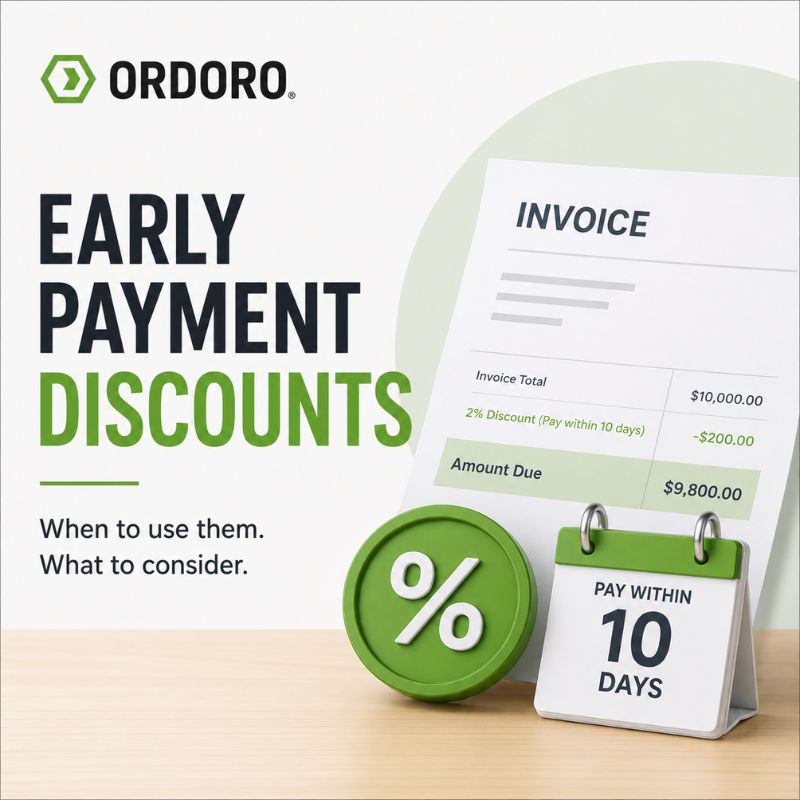
The payment term 2/10 net 30 means the buyer receives a 2% discount when the invoice is paid within 10 days. Otherwise, the full invoice amount is due within 30 days.
For a $10,000 invoice:
- Payment within 10 days: $9,800
- Payment after day 10 but by day 30: $10,000
- Savings from paying early: $200
The buyer is effectively paying $9,800 twenty days early to avoid paying an additional $200.
How to Calculate the Cost of Skipping the Discount
A useful way to evaluate an early payment discount is to calculate the annualized cost of not taking it.
For 2/10 net 30 terms, the formula is:
Discount ÷ Amount Paid After Discount × 360 ÷ Extra Payment Days
Using the example:
2% ÷ 98% × 360 ÷ 20 = approximately 36.7%
This means that choosing to hold the $9,800 for another 20 days and then paying $10,000 carries an annualized cost of roughly 36.7%.
That does not mean the business literally pays 36.7% interest over one year. It is a way to compare the value of the discount with other uses of the company’s cash.
When Should a Buyer Take an Early Payment Discount?
Taking the discount may make sense when:
- The business has enough cash to pay early
- Paying early will not interfere with payroll, taxes, inventory purchases, or other obligations
- The annualized savings are greater than the company’s borrowing or investment costs
- The invoice and goods have been verified
- The payment can be processed before the discount deadline
Even when the financial return looks attractive, available cash may be the deciding factor. A business should not create a larger cash-flow problem simply to capture a discount
When Should a Seller Offer an Early Payment Discount?
Offering an early payment discount may make sense when faster payment is worth more to the business than the revenue given up through the discount.
Consider:
- How urgently the business needs cash
- The cost of borrowing elsewhere
- The risk of customers paying late
- The effect of the discount on gross margin
- Whether the customer is likely to pay early
- Administrative costs associated with collections
- Whether shorter standard payment terms would work instead
For example, offering a $200 discount to receive $9,800 twenty days earlier may help a business fund inventory, payroll, or other immediate operating needs. But if margins are already narrow, repeatedly offering the discount could reduce profitability.
Buyer and Seller Perspectives
The same discount creates different considerations for each side.
- For the buyer, the question is whether using cash early produces a better return than keeping that cash for another 20 days.
- For the seller, the question is whether receiving cash earlier is worth giving up part of the invoice value.
The decision should be based on cash flow and financing costs rather than on the discount percentage alone.
What does 2/10 net 30 mean?
It means the buyer can deduct 2% from the invoice when payment is made within 10 days. Otherwise, the full amount is due within 30 days.
Is an early payment discount worth taking?
It may be worthwhile when the savings exceed the buyer’s financing cost and paying early will not create cash-flow problems.
Why would a seller offer an early payment discount?
A seller may offer one to collect cash faster, reduce outstanding receivables, lower collection risk, or fund immediate operating needs.
How do you calculate the annualized cost of skipping a discount?
Divide the discount percentage by the amount remaining after the discount, then multiply by the number of discount periods in a 360-day year.
For 2/10 net 30:
2% ÷ 98% × 360 ÷ 20 = approximately 36.7%
Connect Purchasing With Inventory Operations
Early payment terms affect more than accounting. They can influence when businesses place purchase orders, receive inventory, replenish products, and commit cash to suppliers.
Ordoro helps eCommerce businesses keep purchase orders, receiving, inventory, orders, and shipping organized in one operational system. Better visibility into purchasing and inventory can give accounting teams clearer information when evaluating supplier terms and cash needs. Explore Inventory Management
- Commerce Corner: Big News, Fresh Features & Free Swag
- Haven’t Checked Your Walmart Seller Account Lately? You Might Want To.
- eBay Sellers Got a Glimpse of Higher Ad Costs. Then Came the Explanation.
- Small Brands Could Have a Big Holiday Advantage
- Meta Muse Can Shop Like a Customer. Should Merchants Treat It Like One?