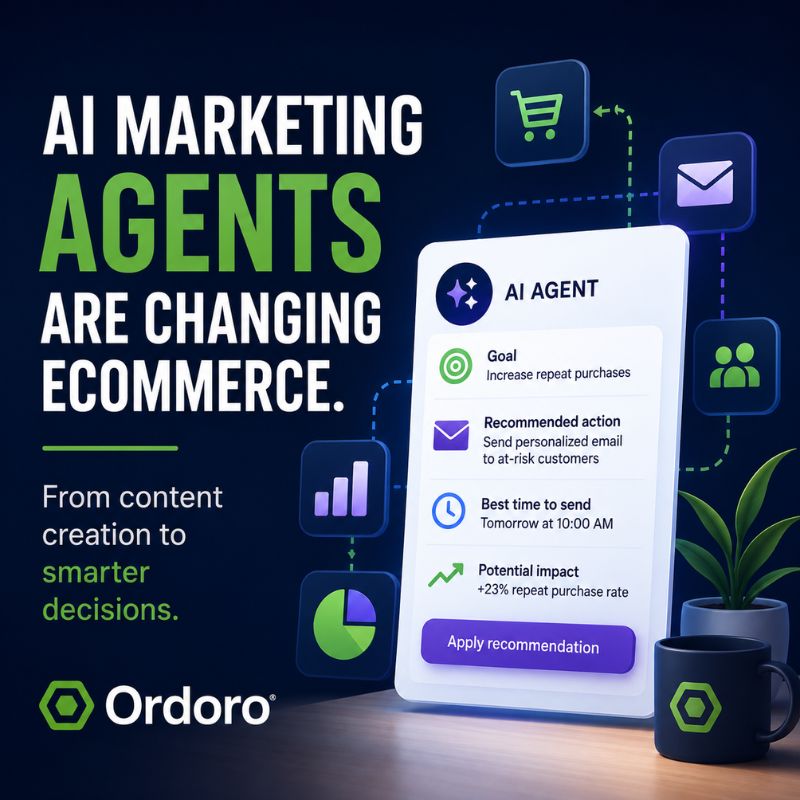
AI marketing agents represent the next evolution of artificial intelligence in eCommerce. Today, merchants use AI to write product descriptions, generate email subject lines, create social media posts, and answer customer questions. For many businesses, AI has become another tool that saves time and helps teams get more done. Until now, most AI tools have focused on completing individual tasks.
The next generation of AI isn’t just designed to create content. It’s being built to analyze data, recommend actions, and help merchants achieve specific business goals. Instead of asking AI to write an email campaign, businesses may soon ask it to increase repeat purchases or improve customer retention, then let the technology recommend the best strategy.
That’s the idea behind Klaviyo’s new Marketing AI Agents. While the feature is still in beta, the announcement signals something much bigger than a new product launch. It reflects how AI is evolving from a helpful assistant into a tool that can support decision-making across eCommerce.
The Story Behind the Headlines
Klaviyo recently introduced a beta program for Marketing AI Agents, a new set of tools designed to help eCommerce businesses automate more of their marketing workflows.
Rather than simply generating email copy or suggesting subject lines, the AI agents are designed to work toward specific business goals. Depending on the task, they can recommend customer segments, identify campaign opportunities, suggest messaging, and help merchants improve marketing performance over time.
The technology is still in beta, and merchants remain in control of the final decisions. The goal isn’t to replace marketers. It’s to reduce repetitive work so businesses can spend more time focusing on strategy and less time managing day-to-day marketing tasks.
At a Glance
- Klaviyo launched a beta for Marketing AI Agents.
- The tools are designed to automate marketing workflows and recommendations.
- Merchants remain in control of campaign approvals.
- AI is expanding beyond content creation into decision support.
Why This Matters Beyond Klaviyo
For the last few years, most conversations about AI have centered around content creation. Businesses wanted to know whether AI could write emails, generate product descriptions, create social media posts, or build ad copy. Those capabilities have become increasingly common, and for many merchants they’ve already become part of everyday operations. The next wave of AI looks different.
Instead of asking AI to complete one task at a time, merchants are beginning to ask it to solve business problems. Rather than writing a marketing email, AI may recommend which customers should receive it, determine the best time to send it, and monitor performance once the campaign is live.
That’s a significant shift because it changes the role AI plays inside a business. Instead of acting like a copywriter, it’s beginning to function more like an advisor.
AI Is Becoming Part of the Team
One of the biggest misconceptions about artificial intelligence is that it’s designed to replace people. For most eCommerce businesses, that’s probably not where this technology is headed. Instead, AI is becoming another member of the team.
It can process customer data faster than a person, identify patterns that might otherwise go unnoticed, and surface recommendations based on thousands of data points. Merchants still provide the creativity, brand voice, and business judgment that technology can’t replace. The goal isn’t to remove people from marketing. It’s to give them better information so they can make better decisions.
That’s why we’re seeing AI expand into nearly every part of eCommerce, from customer service and inventory forecasting to product recommendations and marketing automation.
What Merchants Should Take Away
You don’t need to adopt every new AI feature the moment it’s announced. Technology changes quickly, but successful eCommerce businesses have always focused on solving real problems instead of chasing every new trend. The businesses seeing the biggest benefits from AI are typically the ones using it to improve existing workflows rather than completely reinvent the way they work.
This is a good time to evaluate where AI could genuinely save time or improve decision-making inside your business.
Consider asking yourself:
- Which marketing tasks consume the most time every week?
- Could AI help your team better understand customer behavior?
- Are you using AI simply to create content, or to improve business decisions?
- Would automation free your team to focus on higher-value work?
The answers to those questions will likely be more valuable than adopting every new AI feature that comes to market.
From Assistant to Advisor
Klaviyo’s announcement reflects a broader shift happening across eCommerce. Artificial intelligence is quietly moving beyond content creation and becoming part of everyday business operations. Today’s AI tools don’t just generate ideas. They’re beginning to analyze information, recommend actions, and automate workflows that once required constant manual attention. That doesn’t mean merchants are giving up control.
Instead, they’re gaining another tool that can help them work more efficiently, respond to customer behavior more quickly, and make decisions with greater confidence. As AI continues to mature, we’ll likely see it play a larger role in inventory planning, pricing, customer service, marketing, and fulfillment.
The businesses that benefit most probably won’t be the ones using the most AI. They’ll be the ones using AI to solve the right problems.
Key Takeaways
- Klaviyo launched a beta program for Marketing AI Agents.
- AI is evolving beyond content creation into workflow automation and decision support.
- Merchants remain in control while AI helps reduce repetitive work.
- Businesses should focus on AI tools that improve efficiency and support better decision-making.
Frequently Asked Questions
What are Klaviyo Marketing AI Agents?
Marketing AI Agents are AI-powered tools designed to help merchants automate marketing workflows, recommend strategies, and improve campaign performance based on business goals.
Will AI replace eCommerce marketers?
Probably not. AI is better suited to handling repetitive tasks, analyzing data, and identifying patterns, while people continue making creative and strategic decisions.
How can eCommerce businesses use AI today?
Many merchants already use AI for product descriptions, customer support, email marketing, and analytics. New AI agents expand those capabilities by helping automate larger marketing workflows.
Should small businesses invest in AI?
The best approach is to focus on AI tools that solve real business challenges, improve efficiency, and support existing workflows rather than adopting every new feature simply because it’s available.
Where Things Go From Here
Klaviyo’s Marketing AI Agents are still in beta, so it’ll take time to see how merchants adopt the technology and what kind of results it delivers.
The bigger story isn’t whether one new feature succeeds. It’s that AI continues moving deeper into everyday eCommerce operations. As more platforms introduce tools that can analyze data, recommend actions, and automate workflows, merchants will have new opportunities to work smarter while staying in control of their businesses.
We’ll be watching how AI agents evolve, how merchants use them in the real world, and whether they become as common as email automation and customer segmentation.
In the meantime, one thing remains true. Great marketing brings customers to your store, but reliable operations keep them coming back. If you’re looking to simplify inventory management, shipping, and order fulfillment as your business grows, talk to an Ordoro expert to see how connected operations help you deliver on every promise your marketing makes.