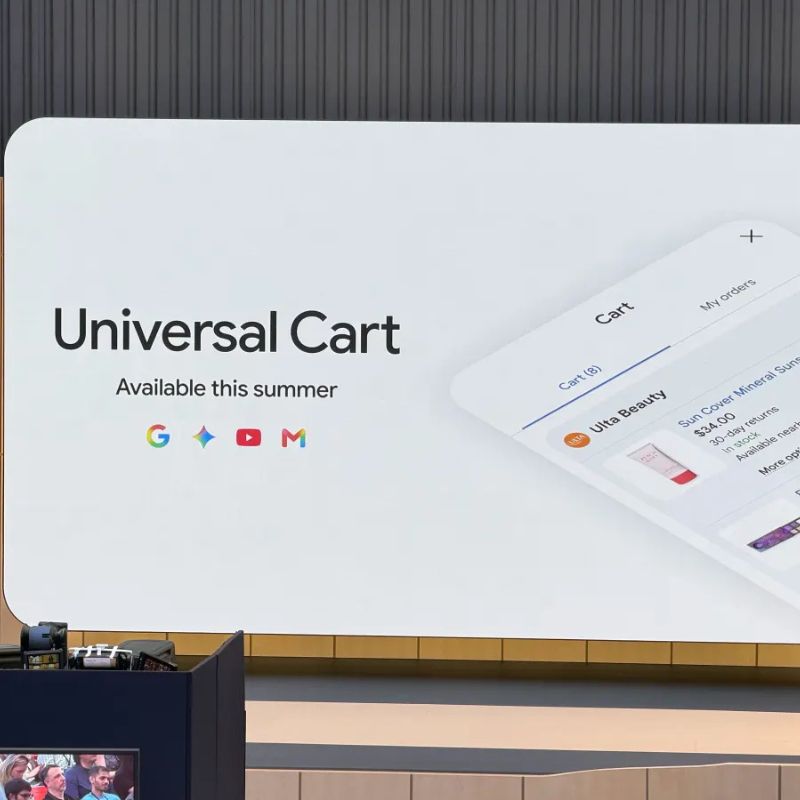
Remember when the biggest eCommerce challenge was getting customers to find your website? Those were simpler times. Today, online sellers are optimizing for search engines, social media algorithms, marketplaces, influencers, email campaigns, and whatever new platform launches next week. Now Google wants to add another player to the mix: artificial intelligence. With the introduction of Google Universal Cart, the company is betting that AI will play a much larger role in how customers discover and buy products online.
At Google I/O 2026, the company unveiled its vision for “agentic commerce,” a future where AI assistants help consumers research products, compare options, track prices, monitor inventory, and potentially make purchasing decisions on their behalf. One of the biggest announcements was Universal Cart, a new system designed to connect shopping activity across Google’s ecosystem, including Search, Gemini, YouTube, and Gmail.
If that sounds a little futuristic, you’re not alone. It also raises a fascinating question for eCommerce businesses: what happens when your next customer is not actually shopping, but their AI assistant is?
What Google’s Universal Cart Can Do
According to Google, Universal Cart is designed to make shopping more seamless across its ecosystem by connecting activity across Search, Gemini, YouTube, Gmail, and other Google products. Features include:
- Tracking products across multiple Google services in one place
- Monitoring price drops and sales
- Alerting shoppers when products come back in stock
- Surfacing relevant coupons and promotions
- Helping customers compare products and alternatives
- Remembering items shoppers have viewed or considered
- Supporting AI-powered recommendations based on shopping preferences
- Creating a more connected shopping experience from product discovery to purchase
While many of these features already exist in some form across Google’s shopping tools, Universal Cart brings them together under a broader vision of AI-assisted shopping, or what Google calls “agentic commerce.”
From Search Engine to Shopping Assistant
For years, Google’s role in eCommerce has been relatively straightforward. Someone searches for a product, Google helps them find it, and the retailer takes it from there. Now the company appears to be preparing for a future where customers may not search the way they used to.
As AI tools become more popular, consumers are increasingly asking conversational questions instead of typing traditional search queries. Rather than scrolling through pages of links, many users now expect AI to summarize information, compare options, and help narrow decisions quickly. Google’s latest announcements make it clear the company wants to stay at the center of that experience instead of letting standalone AI platforms become the primary destination for product discovery. That helps explain why Google is pushing deeper into AI-powered shopping experiences.
Imagine a customer watching a product review on YouTube. Later that day, Gemini notices the item has gone on sale. A few days later, Google surfaces a coupon from their inbox and alerts them that inventory is running low. Instead of hopping between websites, tabs, and apps, the customer has an AI assistant quietly helping them make a buying decision.
Convenient? Absolutely. A little creepy? Also absolutely.
Either way, it is becoming increasingly clear that Google believes shopping is headed in this direction.
Your Future Customer Might Ask AI Instead of Google
For eCommerce sellers, the biggest takeaway is not the Universal Cart itself. It is the changing behavior behind it. Historically, customers searched for products. Tomorrow’s customers may simply ask questions.
Instead of searching “best office chair,” they might ask:
- What is the best office chair under $300?
- Which office chair has the fewest returns?
- What chair can arrive by Friday?
- Which chair is currently on sale?
The difference may seem small, but it changes how products are discovered. Rather than scrolling through pages of results, customers could increasingly rely on AI-generated recommendations to narrow the field.
For online sellers, that creates an interesting challenge. It is no longer just about getting customers to your website. It may also become about making sure your products are the ones AI recommends in the first place.
Inventory Just Got a Lot More Interesting
One detail that stood out from Google’s announcements was the emphasis on product availability and inventory. That might not sound exciting until you think about what happens if AI becomes part of the shopping process.
Imagine asking an AI assistant for a product recommendation and receiving three options. One is out of stock. One has a two-week shipping delay. One is available right now. Which one do you think gets recommended?
As AI shopping experiences become more sophisticated, accurate inventory information could become even more valuable than it already is. Nobody wants their products recommended only for customers to discover they cannot actually buy them. For eCommerce businesses, operational accuracy may become part of marketing. That is a sentence that would have sounded ridiculous five years ago.
Is This the Future of eCommerce?
Maybe. The eCommerce industry has a long history of predicting dramatic changes that take much longer to arrive than expected. Voice commerce was supposed to take over shopping. QR codes were supposedly dead before becoming popular again. We were also told we’d all be getting drone deliveries by now. AI shopping assistants may follow a similar path.
What makes this story different is the number of major companies investing in the concept. Google, Shopify, OpenAI, Amazon, and others are all exploring ways to make AI a larger part of the buying experience. That does not mean eCommerce websites are disappearing anytime soon. It does suggest that product discovery may start happening in places merchants never expected.
What eCommerce Businesses Should Do Now
The good news is that online sellers do not need to reinvent their businesses tomorrow. The same fundamentals that matter today will likely matter tomorrow:
- Accurate inventory
- Clear product information
- Reliable fulfillment
- Competitive pricing
- Great customer experiences
The businesses that succeed will be the ones that can adapt when new shopping channels emerge, whether those channels are marketplaces, social media platforms, or AI assistants making recommendations on behalf of customers.
After all, if Google gets its way, your next customer may not spend hours comparing products online. Their AI might handle that part for them.
Frequently Asked Questions
What is Google’s Universal Cart?
Universal Cart is Google’s new shopping initiative designed to connect shopping activity across Search, Gemini, YouTube, Gmail, and other Google services.
What is agentic commerce?
Agentic commerce refers to AI systems that can help consumers take actions such as comparing products, tracking prices, monitoring inventory, and assisting with purchases.
How could AI change eCommerce?
AI may become a major product discovery channel, helping customers find, compare, and evaluate products before making purchasing decisions.
Why is inventory accuracy important for AI shopping?
AI-powered shopping experiences depend on accurate product data and availability information. Inaccurate inventory can lead to poor customer experiences and missed sales opportunities.
Will AI replace eCommerce websites?
No. AI is more likely to become another way customers discover products rather than replacing online stores altogether.
The Shopping Journey Is Getting a New Travel Companion
Whether Google’s vision becomes mainstream next year or five years from now, one thing is becoming increasingly clear: AI is moving closer to the checkout process.
For eCommerce businesses, that makes operational accuracy more important than ever. If AI is helping customers find products, compare options, and evaluate availability, merchants need reliable systems behind the scenes to keep up.
If you’re looking for a better way to manage inventory, shipping, and fulfillment as eCommerce continues to evolve, explore Ordoro and see how growing brands are building smarter operations behind the scenes.