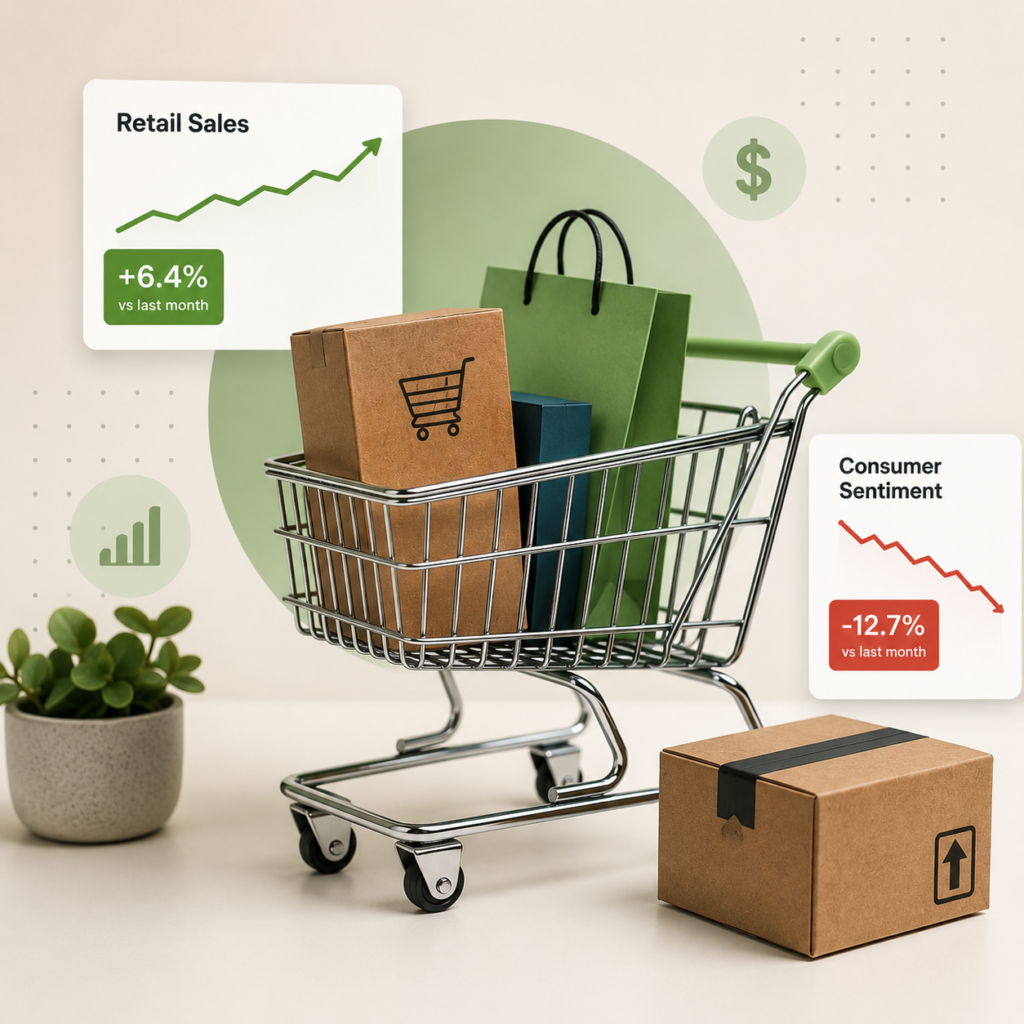
Consumers keep saying they are nervous about spending. Retail sales keep rising anyway. That is becoming one of the stranger patterns in eCommerce right now, especially as consumer spending continues to shift unpredictably.
Recent retail data shows shoppers are still spending across categories even as concerns around inflation, global instability, and the broader economy continue to grow. Consumer sentiment remains shaky, but demand has not disappeared.
For eCommerce merchants, that creates a difficult environment to read. Customers have not stopped spending. They are just behaving less predictably than they used to.
The Hard Part Is Predicting What Happens Next
For a while, weak consumer sentiment usually pointed to the same outcome. People got nervous, spending slowed down, and merchants adjusted accordingly. That is not exactly what is happening right now.
Customers are still buying, but they are becoming more selective about:
- when they purchase
- what they prioritize
- how much they are willing to spend
That creates a very different kind of pressure for eCommerce brands. Demand is still there, but it is less consistent. One week sales look strong. The next week things slow down unexpectedly. Promotions move inventory faster than expected, but forecasting becomes harder because customer behavior keeps shifting.
The Hard Part Is Planning Around Uncertainty
This is where a lot of merchants start to feel stuck. If demand completely disappeared, This is where a lot of merchants start to feel stuck. If demand completely disappeared, the response would be obvious. Cut back inventory, slow purchasing, reduce expenses.
But that is not the environment right now.
The challenge is that customers are still shopping enough to create growth opportunities while also behaving cautiously enough to make planning difficult.
That tension creates operational problems:
- inventory levels become harder to forecast
- stockouts happen faster during spikes
- overstock becomes more expensive if demand suddenly slows
And because buying behavior keeps shifting, merchants end up reacting more often instead of planning ahead. Promotions that worked a month ago suddenly feel less predictable. Products that usually move steadily can spike unexpectedly. Inventory decisions start feeling less like strategy and more like guesswork.
This is where uncertainty starts moving behind the scenes into operations.
For a lot of growing brands, the issue is not demand. It is visibility. The harder customer behavior becomes to predict, the more important it becomes to know exactly what inventory you have, where orders are coming from, and how quickly you can adapt when things change.
Flexibility Starts to Matter More Than Forecasting
In unpredictable markets, flexibility becomes more valuable than trying to predict every shift perfectly.
The merchants handling this environment best are usually the ones who can adapt quickly when buying patterns change. That often means:
- having visibility into inventory across channels
- adjusting fulfillment decisions in real time
- avoiding operational slowdowns when demand spikes unexpectedly
Because when customer behavior changes week to week, rigid systems become a problem fast.
Demand Is Still There. Consistency Is Not.
One of the more interesting parts of this moment is that ecommerce growth itself has not really disappeared. Platforms like Amazon, eBay, and Etsy are still seeing demand. Consumers are still browsing, buying, and responding to convenience and fast delivery.
What is changing is confidence.And when confidence drops while demand stays active, merchants end up operating in a much less predictable environment. Most customers will never notice whether your backend systems are running smoothly. They only notice when something breaks:
- inventory is unavailable
- orders ship late
- fulfillment slows down during spikes
That is why operational flexibility matters so much in uncertain markets. Merchants need systems that help them respond quickly instead of constantly reacting after problems appear.
This is exactly where platforms like Ordoro become useful. By centralizing inventory, orders, and shipping, merchants can adapt faster when demand shifts without creating more manual work behind the scenes.
FAQs About Consumer Spending and eCommerce Growth
Why are consumers still spending despite economic concerns?
Many shoppers are still willing to spend, but they are becoming more selective about what they buy and when they purchase.
How does unpredictable consumer behavior affect eCommerce merchants?
It makes forecasting harder. Merchants may experience sudden spikes, slower periods, and changing demand patterns that impact inventory and fulfillment.
Why is flexibility important for eCommerce businesses right now?
Flexible systems help merchants adapt quickly when customer behavior changes, reducing issues like stockouts, fulfillment delays, and overstock.
What operational challenges increase during uncertain markets?
Inventory forecasting, order management, and shipping decisions become harder as demand patterns shift more frequently.
How can Ordoro help eCommerce merchants during uncertain demand?
Ordoro helps merchants centralize inventory, orders, and shipping so they can respond more efficiently when demand changes across channels.
The Bigger Shift in eCommerce
The interesting part of this moment is not that consumers are nervous. It is that they are still spending anyway.
That creates a market where merchants cannot rely entirely on either optimism or caution. Growth opportunities still exist, but planning around them becomes more difficult as consumer spending eCommerce trends grow less predictable.
The merchants who handle this well will not necessarily be the ones with the biggest marketing budgets. They will be the ones flexible enough to adapt as buying behavior keeps changing.
Because right now, the challenge is not finding demand. It is keeping up with how quickly it changes.
If your current systems already feel stretched when demand spikes or customer behavior shifts unexpectedly, this is a good time to take a closer look at how your operations are structured. See how Ordoro can help.
- Your eBay Shipping Costs Might Look Different This Holiday Season
- Features and Updates
- How eCommerce Picking and Packing Works
- 2026 Holiday Shipping Surcharges: UPS, FedEx, USPS & DHL
- Kitting in eCommerce: How Kits and Bundles Affect Inventory