
Cost of money calculation refers to the average interest rate at which you are able to borrow money. Think of the cost of money as the rent you have to pay for using someone else’s money.
Cost of Money Applies Even When Using Your Own Cash
Yes, there is a cost of money even if you are using all of your own money. How? Since you are using your own money instead of putting it into a savings account, you are foregoing the 1.5% interest you could make on it. Thus, the cost of money in this case is 1.5%.
As a small business owner, you probably borrow money from several sources, e.g., bank, credit cards, friends. You probably also keep money in various places, e.g., checking account, savings account. Each of these sources has its own cost of money: A bank loan could cost you 10%, a credit card could cost you as much as 30%, and so on and so forth. So how do you come up with the combined cost of money that tells you how much interest you are paying for all of this borrowed money?
The short answer is that your cost of money is the weighted average of your borrowing and deposit interest rates. Too much jargon? Don’t worry. In the next section I will explain how to calculate your cost of money in 4 simple steps.
What is the Cost of Money?
The cost of money refers to the expense associated with using capital over time. This typically includes interest rates, opportunity costs, and any fees tied to borrowing or investing funds.
In eCommerce, the cost of money often shows up in inventory decisions. When cash is tied up in products sitting on shelves, that money cannot be used elsewhere—creating a real, measurable cost to the business.
Cost of Money Formula
Cost of Money = Interest Rate × Capital × Time
This formula helps estimate how much it costs to hold or use money over a given period.
4 Simple Steps to Calculate the Cost of Money for Your Small Business
Let us create a spreadsheet with 4 columns.
Step 1 (Column A) – Identify all of the sources of money for your business and list them in order. These sources are often:
- Small business loans from a bank or SBA.
- Credit cards. If you use multiple credit cards, then list the amounts your have charged on each one of them separately. (Note: Do not list your credit limit, but rather your outstanding balance. If your outstanding balance changes every month, your cost of money will also change every month.)
- Friends or family who have lent you money to run your business. (Write down the amount even if they are not charging you any “interest” on the loan.)
- If your business has cash lying in a checking or saving account, list that too.
Example of Cost of Money Calculation: Let’s say you invest $10,000 into inventory, and your annual cost of capital is 10%.
Your annual cost of money would be: $10,000 × 10% = $1,000
If that inventory takes six months to sell, your cost of money is approximately $500 for that period.
Step 2 (Column B) – Next to each source, write down the interest rate you are paying.
For SBA, this rate can be easily found in your documents. If you use multiple credit cards, write down the APR of each card separately. You can find out the APR from your credit card statements, or you can call the credit card companies.
Step 3 (Column C) – Apply a + or – sign to each source.
- If your business has “borrowed” money from that source, then use a + sign. Bank loans, SBA loans, Credit cards, Friends/Family will get a + sign.
- If you business has “deposited” money into that source, then use a – sign. Your business checking account balance and your savings account balance will all have – signs.
Step 4 (Column D) – Time to find your weighted average.
You can do this by simply multiplying column A with Column B, and applying the sign in Column C to get Column D. (See table below.)
Once you finish Step 4, now, add all of the rows in Column A and all of the rows in Column D. After you do that, divide the Column A total by the column D total. This amount is the cost of money for your business. Simple, huh?
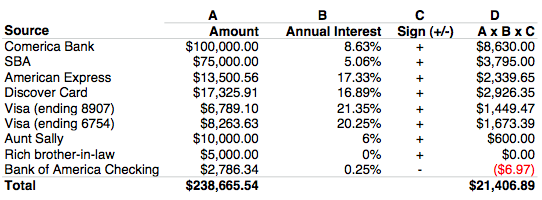
Cost of Money = $21,406.89 / $238,665.54 = 0.0897 = 8.97%
As you can see, the cost of money is the weighted average interest rate for the money supply into your business.
Applying cost of money as a metric
Cost of money is a very useful metric in making business decisions. For example, cost of money can be used to decide whether to offer / accept early payment discounts.
Frequently Asked Questions
What is the cost of money in simple terms?
It is the cost associated with using or holding money over time, often measured as interest or opportunity cost.
How do you calculate cost of money?
A basic calculation is: Interest Rate × Capital × Time.
Why does cost of money matter in eCommerce?
Because cash is often tied up in inventory, and slow-moving products increase financial costs.
How Inventory and Fulfillment Impact Cost of Money
For eCommerce businesses, the cost of money is closely tied to how efficiently inventory moves.
Slow-moving inventory increases holding costs and ties up capital that could otherwise be reinvested into growth. At the same time, stockouts can lead to missed revenue opportunities.
Tools like Ordoro help merchants manage inventory more effectively, reduce excess stock, and improve how quickly products move from purchase to delivery.
Start a free trial of Ordoro to see how better inventory management can reduce your carrying costs and free up cash for growth.
 About the author
Jagath Narayan is the CEO and co-founder of Ordoro, the #1 eCommerce platform for retailers growing from 10 orders/day to 10,000 orders/day. Follow him on LinkedIn to learn more about Entrepreneurship and eCommerce.
- Haven’t Checked Your Walmart Seller Account Lately? You Might Want To.
- eBay Sellers Got a Glimpse of Higher Ad Costs. Then Came the Explanation.
- Small Brands Could Have a Big Holiday Advantage
- Meta Muse Can Shop Like a Customer. Should Merchants Treat It Like One?
- Print Barcode Labels While Receiving Inventory in Ordoro